GDPR Set to Transform Data Landscape

It’s nearly 20 years since the Data Protection Act came into force and since then, we have moved into a digital and social media age, with significant increases in data use, processing and storage. It is with these changes in mind that the General Data Protection Regulations (GDPR) will be implemented in the UK on May 25th next year.

Personal data, business or consumer-related, comes under the scope of GDPR so every business in the UK will be affected. Fines for breaches could be up to 4% turnover.

Probably one of the biggest challenges surrounds proven consent to use the data in the way you intend. But GDPR is very far-ranging. For more information on this important new legislation, visit the Information Commissioner Office.

Through its membership of Build UK, RIDBA will be issuing further guidance to members on GDPR compliance.

Wind Loading on Agricultural Buildings

All buildings and other external structures are subjected to wind loading which, over the 20 to 50 year design life of the building, may on occasion be sufficiently strong to cause damage to the cladding and even the building structure. It is therefore essential that this loading is properly accounted for during the design and construction of the building. It is not uncommon to see news footage of roof and wall cladding being ripped off and blown about during severe winter storms and of structural damage to temporary structures and older buildings. It is thankfully rare for modern buildings to fail structurally due to wind loading alone, although this is no reason to be complacent. RIDBA is aware of several instances where buildings have swayed excessively during high winds, resulting in complaints from concerned building owners. Excessive deflections can lead to damage to the building envelope and ancillary components attached to the frame, requiring costly remedial action that could have been prevented by proper consideration of the likely wind loading at the design stage.

Wind forces on buildings

When the wind blows over or around a building, it is forced to change direction and either speed up or slow down depending on the shape and orientation of the obstruction. This causes either an increase or decrease in the external air pressure. When combined with changes to the internal air pressure the result is either a net positive pressure (on windward facing walls and the windward slopes of steep roofs) or a net suction (on leeward facing walls, walls parallel to the direction of the wind and on roofs generally). Importantly, the magnitude of the pressure is proportional to the square of the wind speed, so doubling the wind speed will produce four times the wind loading on the building.

From a building design point of view, the most important point to understand is that wind speed varies enormously with location and building geometry, meaning that wind loading is site and building specific, so should be calculated for each and every building project. Since the magnitude of the wind loading has a direct bearing on the design of the frame (e.g. column and rafter sizes), it follows that the design of every building is unique and should be calculated or at least regularly checked. It should come as no surprise that a 15m barn designed for a sheltered location in Oxfordshire may not be adequate if placed on a hilltop overlooking the coast of Cornwall.

Factors affecting the wind speed

Location
Some parts of the country tend to experience higher wind speeds than others and this needs to be taken into account when calculating the wind loading on a building. To enable engineers without specialist meteorological expertise to judge the likely wind speed at a particular location, the available meteorological data has been analysed to produce a contoured ‘wind map’ of the UK, which is published as part of the UK National Annex to BS EN 1991-1-4 and is reproduced below. The values shown on the map are magnitudes of the ‘basic wind speed’ to which correction factors may be applied to take account of wind direction, altitude and exposure conditions.

Wind speed naturally increases with altitude and this is accounted for by a correction factor that is applied to the ‘basic wind speed’. This is especially important for agricultural buildings since many are constructed at altitudes greater than 200m above sea level, where wind speeds are significantly higher than those in low-lying locations.

Distance to sea
The shorter the distance to the sea, the greater the wind speed, since the wind loses energy and speed as it blows across land. The greatest reduction in wind speed occurs over the first few miles, meaning that locations on the coast experience much higher wind loading than sites only 1 or 2 miles inland. Clearly, cliff top sites that combine a coastal location with altitude experience particularly high wind speeds.

Town or country
Agricultural buildings are generally built in exposed locations that do not benefit from the shelter provided by a surrounding town or city. This results in higher wind speeds than would be experienced by comparable buildings located on an urban site.

Topography
Topographical features such as hills can increase wind speed as the air is forced over them. For this reason, it is important for the person calculating the wind loading to have some familiarity with the site and not simply rely on a postcode.

Wind direction
Wind speed is dependent on direction, with the strongest winds generally blowing from the south west. For this reason, when considering other factors such as distance to the sea or to the edge of town, it is important to consider the direction in which this distance is measured. A common approach adopted by engineers is to consider the wind blowing from several points around the compass and to calculate the wind speed for each direction.

Building height
Taller buildings are exposed to stronger winds and this needs to be reflected in the wind loading calculations. For single storey buildings it is common practice to calculate the wind speed for the ridge height.

Standards and software

Wind loading should be calculated using a recognised code of practice, which in the UK means BS EN 1991-1-4. This is one of the structural Eurocodes and is applicable across Europe, although each country has its own National Annex containing nationally determined parameters and specific national recommendations. The calculation method in BS EN 1991-1-4 is complex and requires specialist technical knowledge, so it is essential that wind loading calculations are undertaken by a qualified structural or civil engineer.

By far the simplest approach is to use one of the many software tools currently available. These range from commercially available packages that take account of all of the factors noted above to free online tools that produce reasonable but conservative results with minimal input from the user. Several steel purlin manufacturers include wind loading tools as part of their specification software (free to customers). In many cases, the precise site location may be specified in the software by its postcode or grid reference. Alternatively, various online resources may be used to obtain the grid reference, altitude and other location data. Thanks to Google, even the local topography and surrounding terrain may be surveyed without leaving the office.

Concluding remarks

The design of any steel or timber framed building is dependent on the magnitude of the wind loading acting on the building. Without knowledge of the wind loads, it is impossible to design the frame or to specify the fasteners for the roof and wall cladding. Since the wind loading depends on so many geographical factors in addition to the shape and size of the building, it should be calculated for each and every building project, since no two buildings will be identical. A Eurocode standard (BS EN 1991-1-4) provides recommendations for the calculation of wind loading on structures, but these calculations need to be performed by a qualified engineer. Alternatively, the wind loading may be calculated using software, including free online tools.

Download Press Release

Successful Members’ Meeting

Members-Meeting

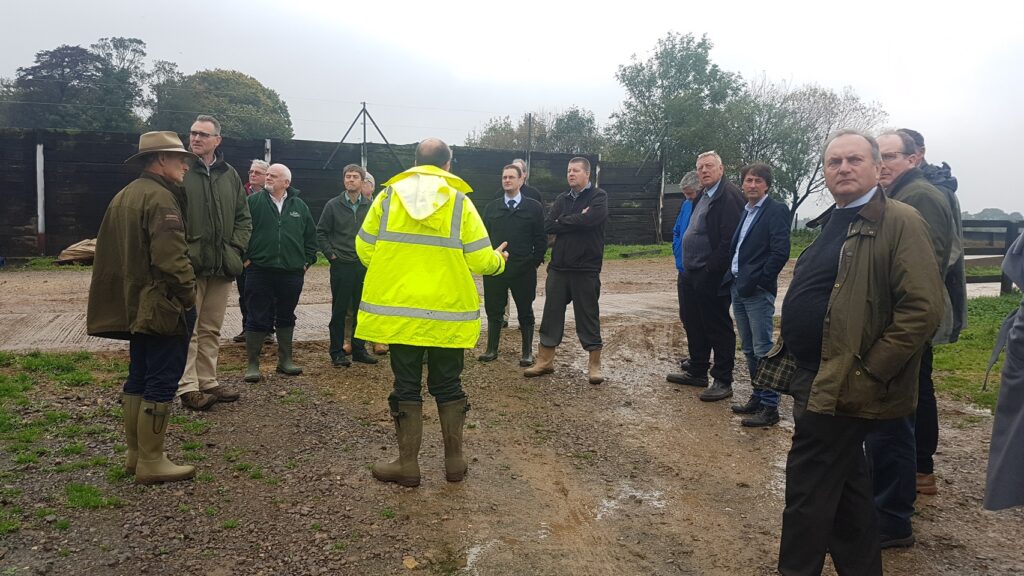
The last RIDBA Members’ Meeting took place at the Bathurst Estate in Cirencester and it was great to have such a good turnout despite the weather! Members were given an update on what RIDBA has been doing over the last few months and what plans were in place moving forward. RIDBA’s Technical Consultant, Martin Heywood also gave an important update on the latest technical matters including CE marking and reminded members of the advisory service that he offers. Delegates were then given a tour of the Estate’s 930-cow dairy farm and 6,000 tonne grain store. A full report will be available in the next RIDBA Journal.

CITB announces Agenda for Change

CITB-Agenda-for-Change-News

As an industry training board (ITB), CITB is asked by the Secretary of State to show that it has continued support from the construction industry every three years — this is known as Consensus. With Consensus achieved, the Government can then authorise CITB to collect a construction levy from employers and invest it in the training that the industry needs.

Whilst a significant majority of members supported the continuation of the Levy, Build UK (of which RIDBA is a member) has made it clear in their letter to CITB that this support is subject to the implementation of a clear reform programme.

CITB is therefore changing its approach, concentrating on three industry priorities:

1. Standards and Qualifications
2. Careers
3. Training and Development

Download the full CITB Agenda for Change 2018.

HSE launches Go Home Healthy campaign

Go-Home-Healthy-News

The Health & Safety Executive (HSE) used its first ever annual conference on 18 September to launch a new occupational health awareness campaign, Go Home Healthy, aimed at a broad spectrum audience ranging from employers, managers and employees to industry sector bodies.

Go Home Healthy is seen as an ‘umbrella’ campaign, creating an overarching message that leads the audience to more specific guidance and information on the HSE’s three priority areas — occupational lung disease, MSDs and work-related stress. The conference was attended by an invited audience of around 300 employers, union representatives, health and safety bodies and sector groups, and was held at the Queen Elizabeth Conference Centre in Westminster.

Go Home Healthy centres on a website that links to HSE guidance, case studies, videos and thought leadership, on the three focal themes. There are also ‘partner pages’ where web users can download collateral from other organisations. The campaign’s title of ‘Go Home Healthy’ is said to represent the overall goal and ‘promise’, rather than an exhortation to workers to consider their own health risks.

Discussing the link with the sector plans, Peter Brown, the HSE’s deputy director of work and health, said: “We’re trying not to have health as a standalone, but to integrate health into the sector plans.

We think of the strategy as having ‘warp and weft’ — you can trace the threads of different issues across the various sectors, for example MSDs in the waste and recycling sector, and stress in the public services.”

Following the HSE’s stress summit in March 2017, attendees heard that there will be a summit on occupational lung disease in November this year, and a summit on MSDs in March 2018. At the conference, Brown explained that there will be a rolling programme of events every six months, with the themes of the conferences repeated every 18 months. In November 2018, there will be a second summit on stress, with the 18-month gap timed so that more evidence, case studies and learning will be available.

In terms of enforcement and inspection activity, Brown told Health and Safety at Work that the HSE’s three to five year plan would have various emphases throughout that time, with the manufacturing sector and MSD hazards being a current focus for inspectors in the HSE’s field operations team. “A big initiative for the Field Operations Division this year is to do inspections in the manufacturing sector, particularly around MSDs, and if we were to find that things were not up to scratch, there is the possibility of enforcement action. Then we would amplify that through an effective communications strategy. We’re keen to amplify anything that does happen. We also know how word gets around, employers hear about inspections through their own networks, and we will do what we can to draw attention to it.” Future years would bring a different focus, he said. “In three years’ time, it might be we do more field [operations] activity in the waste and recycling sector.”

The HSE has also added a fourth strand to its health campaign, on occupational health leadership. A new health leadership section has been added to the HSE’s website, asking practitioners to submit examples of “what good looks like”, for example in 30 second video clips. Brown explained that this additional focus was the result of feedback the HSE received at stakeholder events under the Helping GB Work Well campaign. “The feedback from our roadshows is that there is a desire for peer to peer learning. People ask: ‘Has anyone like me done something similar?’ As a regulator we can facilitate that kind of dialogue. The health leadership strand will say: ‘Good occupational health looks like this.'” It also encourages holistic approaches to health interventions, he explained. “We don’t want people to focus on stress while others are breathing in stone dust or diesel fumes.”

Brown also stressed that the HSE wanted to join forces with other organisations that were already campaigning on workplace health issues. “We want to see sectors step up and own a problem, in the way the Health in Construction Leadership Group has, or the Chemical Industries Association, which runs its own health leadership awards. We would like that to be seen at every level. We very much want to partner up, there has been very good work done by others, and we don’t want to set up as a confusing alternative. We want to link up with other players.”

Farm Building Design and the Well-being of Livestock

Image-Courtesy-of-Glendale-Engineering-Milfield-Ltd

RIDBA Technical Consultant, Dr Martin Heywood, looks into some of the key areas that should be addressed by building designers and farmers to improve the well-being of their livestock.

Introduction

It is essential that animal housing provides a comfortable, clean and dry environment, free from hazards and health risks. The design of the building and specification of the materials used to construct it play a major role in achieving these aims and, if done properly, can lead to healthier, happier and more productive animals.

Ventilation

The provision of adequate ventilation is arguably the most important consideration when designing a new building for animal housing. A distinction needs to be made between a well-ventilated building and a draughty one. Nobody, human or animal, wants to live in a draughty building that lets in cold air whenever the wind blows, causing discomfort and potentially ill health. On the other hand, a regular supply of fresh air is essential to replenish oxygen, remove exhaled carbon dioxide and control temperature and humidity. Correct ventilation will reduce relative humidity and the risk of respiratory infections, eliminate stagnant air and avoid unwanted draughts.
Factors to consider when designing a building for ventilation include: the dimensions of the building and layout of any internal partitions; the proposed occupancy of the building; and factors affecting the local wind speed, including building location, altitude, shelter and proximity of other buildings.
Even at fairly modest wind speeds, the ventilation of a typical livestock building will be governed by the ‘wind effect’, meaning that sufficient fresh air will be supplied naturally by the wind. A building containing livestock must, however, be adequately ventilated even on the calmest of days, relying on what is known as the ‘stack effect’ (warm air rising replaced by cooler air). The adequacy of stack effect ventilation for a given building will depend on the location and size of the inlets, the location and size of the outlet vents and the heat generated by the livestock. A detailed design procedure for calculating stack effect ventilation is given in the RIDBA Farm Buildings Handbook.

Condensation

Condensation occurs on a surface when the temperature falls below the dew point for a given relative humidity. Condensation does not cause high humidity, but may be a symptom of it if the temperature is low enough. Although condensation can be a nuisance if it results in dripping water, it is high humidity (i.e. moisture in the air) that causes health problems in livestock. The focus for the building designer should, therefore, be on reducing humidity through good ventilation rather than hiding the problem through the use of absorbent materials.

Other considerations

Buildings used for housing livestock should have adequate levels of lighting, provided by natural or artificial means, or a combination of the two. Natural daylight is normally provided by in-plane rooflights, often arranged in bands along the roof. Since rooflights allow direct sunlight to enter the building, there is a risk of overheating in summer if the percentage area of rooflights is too great. It may be possible to use a smaller area, and therefore reduce the overheating risk, by specifying cladding with a highly reflective coating on the inside. Surface finishes should be smooth and without sharp projections to avoid injury to animals or people. Walls should have a washable inner surface that can easily be hosed down and floors must be non-slip.

Conclusions

With careful consideration at the design stage, it is possible to create a healthy and pleasant environment, with adequate fresh air, and lighting, humidity and temperature levels that are comfortable for the animals. Good ventilation and careful specification of materials are the most important factors.

Download Press Release

*Image Courtesy of Glendale Engineering (Milfield) Ltd

National Structural Steelwork Specification

The 6th Edition of the National Structural Steelwork Specification for Building Construction (NSSS) has now been released.

The NSSS is the national standard for specifying structural steelwork for use in building. The 6th edition supersedes the 5th edition (CE Marking version) of the NSSS and tender documentation and construction contracts should be changed to reference the 6th edition of the NSSS for the steelwork specification.

The 6th edition can be used for all types of building construction designed for static loading and is based on Execution Class 2 structural steelwork designed in accordance with BS 5950-1 or BS EN 1993-1-1 (including BS EN 1993-1-8 and BS EN 1993-1-10) and executed in accordance with BS EN 1090-1 and BS EN 1090-2.

Codes and Standards for Agricultural Buildings

Eurocodes

Agricultural buildings in the UK are designed to a British Standard and for the structural aspects of the design that standard is BS 5502-22:2013. This standard is only the tip of an iceberg concerning design documents – which a structural engineer has to use to determine the loading on the building, and to design a suitable structure to carry it. This article aims to untangle the web of codes and standards in use today, explain the relationship between them and inform readers of changes on the horizon.

BS 5502-22:2013
BS 5502-22:2013 is the correct standard for the structural design of agricultural buildings. It provides additional information and design data specific to agricultural buildings, along with reduction factors that may be applied to the wind, snow and imposed loads in certain cases. BS 5502-22 was revised in 2013, bringing it up to date with the structural Eurocodes in use across Europe. This enabled structural engineers to use the same software and design methods that they use for commercial and industrial buildings, while maintaining the reductions in loading enjoyed by agricultural buildings in the UK. The previous version of BS 5502-22 has been withdrawn and is no longer a valid design document so it must not be used.

The Eurocodes
The structural Eurocodes, as they are collectively known, are the principal design documents for all types of structures in the UK, ranging from a 12m span barn to a 1200m span highway bridge. They cover the calculation of wind and snow loading and the structural design of members and frames in a range of materials. As the name suggests, they are applicable for use across Europe (and further afield), although each nation has its own National Annex and is able to set Nationally Determined Parameters (e.g. safety factors). Contrary to popular belief, they are not an alternative to the old British Standards like BS 5950; they are the current and only British Standards still supported by the British Standards Institution (BSI).
At the head of the Eurocodes’ family is EN 1990 or Eurocode 0. This standard sets out the basis for structural design and presents the basic design principles. Although for most engineers designing simple structures, it is the place where the load combinations and safety factors are obtained. The detailed design equations and methods are contained within all of the other Eurocodes starting with Eurocode 1.

EN 1991, or Eurocode 1 contains everything that the structural engineer needs to know about loading on buildings and structures. It is divided into several parts, covering a diverse range of loading types, including dead and imposed loads (EN 1991-1-1), snow loading (EN 1991-1-3), wind loading (EN 1991-1-4) and accidental actions (EN 1991-1-7). Other parts include rules for traffic loading on bridges, loading from cranes and machinery and special rules for silos and tanks. There is a UK National Annex for each part.

Eurocodes 2 to 6 (EN 1992, EN 1993, EN 1994, EN 1995 and EN 1996), along with Eurocode 9 (EN 1999), give design rules for specific materials, while Eurocode 7 and 8 (EN 1997 and EN 1998) cover geotechnical design (foundations) and earthquake resistance respectively. For most building structures, the structural engineer will need to use several Eurocodes during the design process, e.g. EN 1992 for the concrete slab, EN 1993 for the steel frame, EN 1995 for the timber purlins and EN 1997 for the foundations. Furthermore, each Eurocode is divided into several parts, giving specific rules and recommendations.
All aspects of steelwork design are covered by EN 1993, including the design of the steel frame and its members (EN 1993-1-1), the connections between members (EN 1993-1-8) and light steel purlins and cladding (EN 1993-1-3). EN 1993 replaced BS 5950 in the UK. Although there appears to be a bewildering number of standards within the Eurocode family, there is a clear hierarchy and each part is written in a way that complements other members of the family. For example, EN 1993-1-3 gives specific rules for cold formed steel members (e.g. light gauge steel purlins), but builds on the general rules given in EN 1993-1-1. This approach avoids unnecessary repetition and prevents contradiction between parts.

EN 1090
Those familiar with the CE marking of steel frames will recognise EN 1090 as the “CE marking standard for fabricating steelwork”. However, in reality this title should only be applied to EN 1090-1, although to date EN 1090-2 has featured heavily in the CE marking process.
The difference between the two standards is important and is explained below:

EN 1090-1
EN 1090-1 is the Harmonised Standard (hEN) for structural steelwork and includes the list of Essential Characteristics that may be declared by the manufacturer, along with the all-important Annex ZA that gives rules for the CE mark itself. As a harmonised standard, EN 1090-1 has one simple aim: To set out the framework for CE marking by stating which properties may be declared and how they should be measured. It sets out requirements for Initial Type Testing (ITT) and Factory Production Control (FPC), but does not directly set requirements for performance. To ensure that a minimum level of performance (and hence safety) is achieved, EN 1090-1 refers repeatedly to EN 1090-2 on matters such as fabrication tolerances and welding. Simply, a manufacturer CE marking to EN 1090-1 declares that its products comply with EN 1090-2 regarding the Essential Characteristics, and produces a set of FPC procedures ensuring this compliance is achieved in practice.

EN 1090-2
EN 1090-2 is the Execution Standard for structural steelwork and includes details on matters such as tolerances and welding. Although often associated with CE marking due to the many cross references from EN 1090-1, compliance with this standard is independent from the CE marking process. It goes much further than the Essential Characteristics declared on the CE label (seemingly lost on many CE marking auditors). Compliance with EN 1090-2 is essential for safety, since the structural engineer’s design calculations are only valid if the steelwork is fabricated to tolerance and welded correctly – clearly stated in EN 1993. Since BS 5502-22 refers to EN 1993 for the steel design and EN 1993 refers to EN 1090-2 for tolerances and welding, it follows that any building that fails to comply with EN 1090-2 automatically fails to comply with BS 5502-22.

Latest code updates
All of the Eurocode documents have been reviewed and are in various stages of being revised, starting with EN 1990. Many of the changes currently being discussed, such as robustness and reliability analysis, will have little impact on agricultural buildings. However there is talk of replacing the equations used to combine snow and wind loading, with possible consequences for design loads. The main parts of EN 1991 and EN 1993 are now at the Working Group stage, where teams of experts from across Europe review the comments received on the existing standards and attempt to address them. Project Teams have just started the process of undertaking detailed technical work that will eventually feed into the revised Eurocodes.

As a general trend, there is a move to reduce the number of Nationally Determined Parameters (NDPs), i.e. the values and equations that may be specified by individual countries through their National Annexes. No major changes to wind and snow loading are expected, although increases in both cannot be ruled out. Similarly, changes to EN 1993 are unlikely to have a significant impact on the design of steel framed sheds, since the underlying physics has not changed. In both cases however, changes to the design methods or equations would require software updates. The Project Teams and Working Groups have been asked to consider ‘ease of use’ aiming to make the Eurocodes easier to follow and navigate.

Perhaps more significantly for steel frame manufacturers, EN 1090-1 and EN 1090-2 are also being revised with potential consequences for CE marking. Changes are proposed relating to the bolting and welding of structural steel, including new guidance on the selection of weld inspection classes and the use of preloaded bolts. Guidance on the selection of the execution class has been removed from EN 1090-2 and may now be found in Annex C of EN 1993-1-1. Requirements for cold-formed steel members and sheeting are now in EN 1090-4. The changes proposed to EN 1090-1 are more fundamental in nature and could see the link broken between this standard and EN 1090-2. If this change is implemented, compliance with EN 1090-2 will no longer be mandatory for CE marking, although it will still be essential for building safety and for compliance with BS 5502-22.

Download Press Release

Huge Success at the RIDBA Building Awards 2017

Building-Awards

The Rural and Industrial Design and Building Association (RIDBA) held the RIDBA Building Awards 2017 at the Radisson Blu hotel in Cardiff on Friday 17 March in front of over 130 industry guests, a record for this event.

The Awards celebrate the successes of RIDBA members over the past two years and showcase the best in rural and industrial buildings, designed and built to the highest standards. The Overall Winner prize was awarded to Shufflebottom Ltd for their work on the CUBRIC Building in Cardiff which stood out for the major impact it has had on the community and the world of science. The Ancre Hill Winery by A.J. Lowther & Son Ltd was also Highly Commended for its dedication to sustainability and the environment.

The winner of the Training Award was A.C. Bacon Engineering Ltd for their commitment to training, benefiting the industry and not just the company.

Building on the success of previous years and back by popular demand, TV presenter and wildlife expert Kate Humble presented the awards, recognising RIDBA members’ commitment to workmanship and quality.

RIDBA Chairman James Anthony said:

“It is an honour to be the chairman of RIDBA at such an important time for the industry. With so many changes over the past year, these awards show how much we have grown as an organisation and demonstrate our dedication to high-quality work. The entries highlight the diverse range of projects that RIDBA members have partaken in, an impressive achievement over the last couple of years. We truly are a varied industry which I am proud to be a part of, and I can’t wait to see what the next year will bring.”

The RIDBA Building Awards 2017 were supported by Filon Products, Joseph Ash, Kingspan, Marley Eternit, Metsec, Steadmans and Farming Monthly as RIDBA’s media partner.

Download Press Release

RIDBA Announces Shortlist for the RIDBA Building Awards 2017

RIDBA-Building-Awards

RIDBA (The Rural and Industrial Design and Building Association) launched the RIDBA Building Awards in September 2016 to showcase the best in rural and industrial buildings and after receiving a record number of entries, RIDBA is delighted to announce the shortlist to the industry.

The re-vamped FAB Awards is now in its third year and superbly demonstrates the diversity of skills of our members, from schools and offices to cattle buildings and stables. As such, RIDBA has divided the entries across seven categories: Cattle, Commercial, Education and Research, Equestrian, Production and Process, Recreation and Leisure, and Storage.

The judging panel consisted of industry experts including David Collier (David Collier Rural Planning), Niresh Somlie (BM Trada), Martin Heywood (RIDBA Technical Consultant) and Andrew Brown (Visit our Farm). The judges were very impressed by the high level of technical excellence demonstrated by RIDBA members delivering successful projects to their clients.

RIDBA is also pleased to announce its media partnership with Farming Monthly for the promotion of the RIDBA Building Awards 2017 providing RIDBA with a unique opportunity to promote the success of its members to the wider industry. RIDBA looks forward to its continued work with Farming Monthly.

Head Judge and RIDBA Technical Consultant, Martin Heywood, said:

“Congratulations to the shortlisted companies who have demonstrated their commitment to high standards and quality. The judges had a difficult task in choosing the winners and with the support of Farming Monthly, I am sure the RIDBA Building Awards will be a true benchmark for the industry.”

The winners will be revealed at the RIDBA Building Awards Dinner on Friday 17 March featuring a champagne drinks reception and a 3-course dinner. The event will be hosted by popular Countryfile presenter Ellie Harrison at the Radisson Blu hotel in Cardiff.

RIDBA would like to thank its sponsors: Kingspan, Joseph Ash, Filon Products, Metsec and Steadmans.

Download Press Release